The "Price" of Breathing Freely
In my clinic I often meet patients who are physically and emotionally drained. They tell me about the relentless cycle of missed sleep, constant facial pressure, and a reliance on medications that offer only fleeting relief. Chronic sinusitis is more than a “stuffy nose”, it is a profound tax on your quality of life. When we begin discussing treatment options, many patients have an equally important concern: Sinus Surgery Insurance coverage and whether their policy will help cover the cost of treatment.
When we determine that Functional Endoscopic Sinus Surgery (FESS) is the “gold standard” path to your recovery, the conversation quickly turns from clinical outcomes to a more pressing concern: “Will my insurance actually cover this?”
As a sinus super specialist and a patient educator, I believe that clarity is as vital as surgical precision. Navigating health insurance in India shouldn’t feel confusing. In this post I will help you plan your journey to relief with confidence.
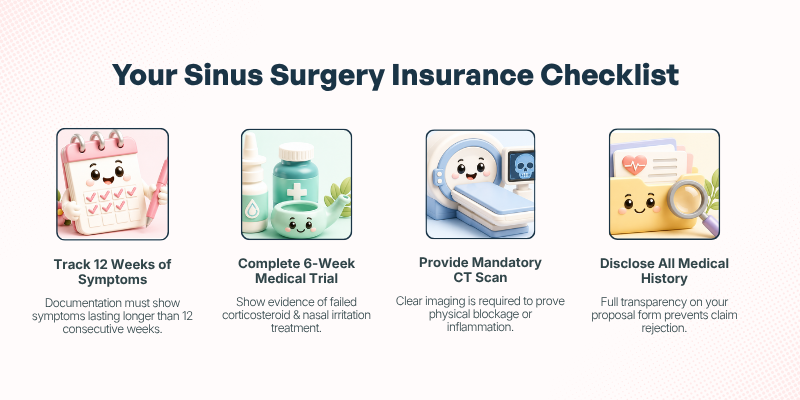
Takeaway 1: It’s Not Just About Symptoms; It’s About the "Rule of Six"
Insurance coverage is predicated on “Medical Necessity,” not just a desire for relief. Having symptoms is the starting point, but for a claim to be approved, you must demonstrate that you have followed a methodical, conservative path first.
Based on clinical guidelines followed by major insurers, coverage typically requires specific clinical documentation of “Medical Management Failure”:
- The 12-Week Rule: Documentation that you are suffering from Chronic Rhinosinusitis (CRS), defined as a persistent episode lasting longer than 12 consecutive weeks.
- The 6-Week Steroid/Irrigation Trial: Evidence of at least six weeks of corticosteroids (oral or nasal) and six weeks of nasal irrigation or lavage.
- The Antibiotic Requirement: Documentation of at least seven days of antibiotic therapy if a bacterial infection was suspected during your treatment journey.
- Objective Imaging Findings: A Computed Tomography (CT) scan is mandatory and must be performed after medical management fails. Insurers look for specific findings: ostial obstruction, mucosal thickening, opacified sinuses, or signs of chronic disease like bony remodeling and bony thickening.
In the eyes of an insurer, surgery is a “conservative and methodical” last resort. We use these criteria not to block your relief, but to ensure that when we do operate, it is the right move for your long-term health.
Takeaway 2: The Indian Insurance "Waiting Game"
Chronic sinusitis is a significant issue in our country, with approximately 1 in 8 individuals in India experiencing chronic sinus infections. Because of this prevalence, Indian insurance providers have specific protocols to manage their risk.
The Waiting Period
Comprehensive plans in India do cover FESS, but coverage is rarely immediate. If your sinusitis is classified as a “pre-existing condition,” you will likely face a specified waiting period. During this time, surgery related to your sinuses will not be covered.
In my experience, I cannot overstate the importance of the Proposal Form. You must disclose your full medical history here. If a history of sinusitis is discovered later that wasn’t disclosed, your claim will likely be rejected. Being treated at an NABH-accredited facility often helps smoothen the documentation process, as our standards of record-keeping align with what top-tier insurers demand.
Takeaway 3: The "Sinus Headache" Trap—Why Your Claim Might Be Denied
One of the most frequent reasons for a denied claim is a lack of objective evidence for the cause of pain. Many patients seek surgery to resolve chronic headaches, but we must be clinically certain of the source.
Research shows that non-sinus causes, like migraines account for the headache in one of every three patients undergoing sinus surgery. To protect you from unnecessary surgery, insurers look for clinical characteristics of “true” sinus pain: it is usually a dull, pressure-like, bilateral periorbital pain (around the eyes) associated with nasal obstruction. If your pain is pulsatile or associated with nausea, it may be a migraine, and insurance will likely deny the claim.
As clinical guidelines strictly state:
“Headache alone should not be considered an indication for endoscopic sinus surgery in the absence of objective endoscopic or radiologic evidence of inflammatory disease.”
Takeaway 4: FESS is a "Doorway," Not Just a "Fix"
In the past, we viewed sinus surgery through a “mechanical model”, simply opening a pipe to let it drain. Today, we understand that surgery is actually a “drug delivery platform.” This shift is why insurers are willing to justify the cost.
Chronic sinusitis is driven by mucosal inflammation that often persists even after the blockages are gone. Insurance covers FESS because it creates a “continuous patent channel.” This surgical transformation allows your post-operative topical medications, like steroid rinses, to actually reach the inflamed tissue.
In fact, studies show that after FESS, the deposition of medication in the sinuses can increase by over 300%. The surgery alters your anatomy in ways that make future, less expensive medical management finally effective.
Takeaway 5: Protecting You Through the "Hard No" (Exclusions)
We sometimes have to tell patients that surgery isn’t the answer. This isn’t about denying care; it’s about protecting you from procedures that lack evidence of efficacy. Insurers have “Hard No” exclusions for similar reasons:
- Allergic Rhinitis: If your symptoms are purely allergy-driven and not associated with obstructive sinus disease, surgery is excluded.
- Sleep Disorders: Using FESS as the primary treatment for Obstructive Sleep Apnea is generally not covered.
- Diagnostic Gaps: Claims are often denied if there is no pre-operative CT scan or no evidence of disease from a nasal endoscopy. Documentation of what the doctor sees through the endoscope is a vital proof-point for your claim.
Conclusion: Navigating Your Path to Relief
Insurance is a powerful tool for your health, but it requires a documented journey. Successful claims are built on a foundation of clinical history: 12 weeks of symptoms, failed medical therapy (including the antibiotic trial), and clear imaging.
At Dr. Rao’s ENT, my philosophy is that clinical excellence and patient education go hand-in-hand. By understanding these requirements, you ensure that your focus remains on healing rather than on paperwork.
If your surgery was the “key” to finally making your medications work, would you still see it as a last resort, or a new beginning?
FAQs
Yes, most comprehensive health insurance plans in India cover sinus surgery (FESS) when it is medically necessary and supported by clinical documentation, diagnostic tests, and specialist recommendations.
Insurers generally require a doctor’s prescription, CT scan reports, nasal endoscopy findings, treatment history, hospital records, discharge summary, and pre-authorization documents for cashless claims.
Yes. If chronic sinusitis is considered a pre-existing condition, insurers may impose a waiting period before covering sinus surgery expenses.
Yes. Claims may be denied if there is no objective evidence of sinus disease, incomplete documentation, lack of a CT scan, or if symptoms are caused by conditions such as migraines rather than chronic sinusitis.
Many insurers offer cashless coverage for FESS when the procedure is performed at a network hospital and all eligibility requirements are met.
Generally, insurance does not cover surgery when symptoms are solely due to allergic rhinitis without evidence of obstructive sinus disease or chronic sinus inflammation.