Does saline irrigation for sinusitis actually work? You’ve heard about neti pots, saline rinses, and nasal irrigation. Your friend swears by it. The internet has conflicting opinions. The honest answer: saline irrigation for sinusitis management works. But there’s a right way and a wrong way. Do it incorrectly, and you’ll waste your time and money.
Does Saline Irrigation for Sinusitis Really Help: The Research
Research consistently shows that saline irrigation for sinusitis reduces nasal congestion and improves sinus drainage, particularly for patients managing chronic rhinosinusitis. The mechanism is straightforward: saline mechanically flushes mucus, debris, inflammatory particles, and environmental irritants out of the sinuses.
Here’s what saline irrigation for sinusitis does: it reduces inflammation and congestion. It prevents bacterial buildup by physically removing pathogens and their biofilms. It works synergistically with medications, often making other treatments more effective. But here’s what it doesn’t do: it doesn’t kill bacteria or infections directly (it flushes them out, but isn’t antimicrobial). It doesn’t cure sinusitis permanently (it manages symptoms and prevents recurrence). It doesn’t work instantly (you need 2 to 4 weeks of regular use before seeing significant improvement).
Think of saline irrigation like brushing your teeth. It prevents problems and maintains health, but it doesn’t cure tooth decay. In my practice, I recommend saline irrigation for sinusitis because it’s evidence-based, not hype.
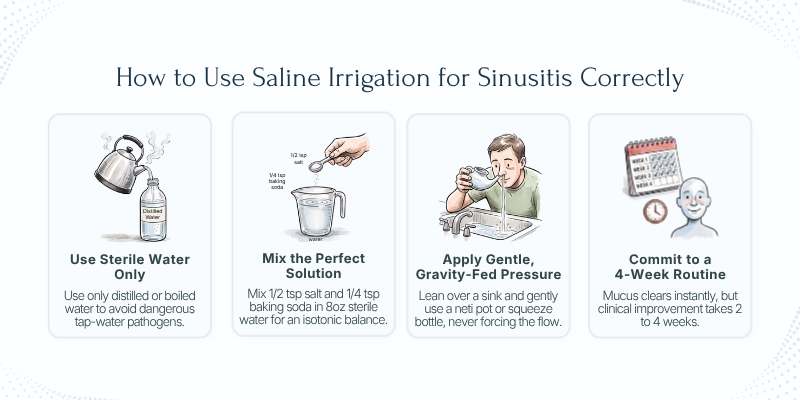
How to Use Saline Irrigation for Sinusitis Correctly
Two main methods work well: the neti pot (traditional, low-cost, but requires practice) and the squeeze bottle (easier for beginners and more intuitive). Both are effective when done correctly.
The critical rule: always use boiled or distilled water. In India, especially in cities like Hyderabad, tap water quality varies significantly. Tap water can harbor bacteria including Naegleria fowleri, which poses serious risks in warm climates. This isn’t optional. Boiled water cooled to room temperature is safe and affordable.
For saline solution, pre-made packets are most convenient and ensure consistent isotonic balance. Alternatively, mix 1/2 teaspoon salt and 1/4 teaspoon baking soda in 8 ounces of boiled water. The salt concentration matters: too much causes irritation and drying, too little creates osmotic discomfort.
Frequency depends on your situation. For daily maintenance, irrigate once daily. If you’re managing active sinusitis, 2 to 3 times daily works better. After sinus surgery (FESS), follow your surgeon’s protocol: typically 4 to 6 times daily for the first two weeks, then gradually taper. Give saline irrigation at least 2 to 4 weeks before judging effectiveness.
When Saline Irrigation for Sinusitis Is Most Effective
Chronic sinusitis management benefits tremendously from regular saline irrigation for sinusitis. It keeps sinuses clear between medications or appointments, reduces dependency on nasal sprays, and helps patients breathe better with fewer symptoms.
Post-surgical recovery is where saline irrigation becomes essential. It clears crusting, debris, and bleeding after endoscopic sinus surgery (FESS). This accelerates healing and reduces swelling significantly. Every post-operative protocol I recommend includes saline irrigation as a cornerstone.
Environmental irritants are everywhere in India: dust, pollution, seasonal pollen. Patients with allergic rhinitis benefit from rinsing out these irritants after outdoor exposure. Combining saline irrigation with antihistamines reduces seasonal severity far more effectively than medication alone. For upper respiratory infections affecting the sinuses, early saline irrigation speeds recovery and reduces the risk of secondary bacterial infection requiring antibiotics.
Common Mistakes and Safety Concerns
The most dangerous mistake is using tap water. I can’t overstate this. Always use boiled or distilled water.
Wrong salt concentration is the second most common error. If irrigation hurts or causes burning, you’re likely using incorrect salt ratios. Stop immediately and adjust.
Force and pressure matter. Never aggressively squeeze saline into your nose. Gentle, gravity-assisted flow is safer. High pressure can push infection deeper into the sinuses and cause discomfort. If it hurts, you’re doing it wrong. Saline irrigation should feel mildly uncomfortable at worst, never painful.
Patience is essential. Patients often quit after one week thinking it doesn’t work. Research shows you need at least 2 to 4 weeks of consistent use to see real improvement. Quitting too early is self-sabotage.
Some patients shouldn’t use saline irrigation: those with active ear infections face drainage risks. Consult your doctor before starting if you have sinus pain during irrigation, persistent bleeding afterward, or recent nasal surgery beyond standard FESS protocols.
When done correctly, saline irrigation is safe with minimal side effects.
Saline Irrigation in My Clinical Practice
Saline irrigation for sinusitis is foundational in my approach to sinusitis management. It’s simple, evidence-based, and empowers patients to control their own sinus health at home rather than depending entirely on office visits or medications.
For post-operative patients, it’s non-negotiable. It accelerates healing, reduces complications, and delivers faster improvement in breathing compared to surgery alone without proper nasal care.
For chronic sinusitis, I often start with saline irrigation combined with targeted medication. Together, they work better than either alone. I customize frequency and technique based on your specific situation: post-op looks entirely different from chronic management.
If saline irrigation isn’t helping after 4 weeks of consistent use, we reassess. Sometimes it means your condition needs additional treatment like medication adjustments, imaging, or other interventions. But in my experience, most patients see meaningful improvement when they use the correct technique consistently.
Ready to Optimize Your Saline Irrigation Routine?
Saline irrigation isn’t magic. But when used correctly, it’s a powerful tool for managing sinusitis and accelerating post-surgical recovery.
Schedule a consultation with Dr. Chaitanya Rao to get personalized instructions on saline irrigation technique and ensure you’re doing it right for your specific situation. You can also explore “The Sinus Book” on Amazon and Flipkart for comprehensive guidance on treatments, recovery, and long-term sinus health management.
Have questions about post-surgical care or saline irrigation practices? Follow @sinus.doctor on Instagram for practical tips and expert insights on sinus care tailored to the Indian context.
FAQs
Yes. Saline irrigation for sinusitis helps flush out mucus, allergens, bacteria, and irritants, reducing congestion and improving sinus drainage. Regular use is especially beneficial for chronic sinusitis and recovery after sinus surgery.
For daily maintenance, once a day is usually sufficient. During active sinus infections, 2–3 times daily may be recommended. After sinus surgery, your ENT specialist may advise 4–6 irrigations per day during the initial recovery period.
No. Always use boiled and cooled, distilled, or sterile water. Using untreated tap water can expose you to harmful microorganisms that may cause serious infections.
Pre-mixed saline packets are the safest and most convenient option. You can also prepare your own solution using ½ teaspoon of salt and ¼ teaspoon of baking soda mixed with 8 ounces (240 ml) of boiled and cooled water.
Most people notice improvement after 2 to 4 weeks of consistent daily use. Saline irrigation works best as part of a long-term sinus care routine rather than as an instant cure.
Yes. Saline irrigation is routinely recommended after Functional Endoscopic Sinus Surgery (FESS). It helps remove crusts, reduces swelling, promotes healing, and lowers the risk of post-operative complications when performed as directed by your surgeon.