That persistent ear fullness that makes the world sound like you’re underwater. The clicking, crackling sensation with every swallow. The muffled hearing that no amount of swallowing or yawning seems to fix. If you’ve experienced any of these, you’re not alone. Eustachian tube dysfunction, or ETD, affects millions of people worldwide, and while it’s rarely dangerous, it can be genuinely frustrating. The good news is that eustachian tube dysfunction treatment has evolved significantly, and many people find relief through approaches that address the root cause rather than just masking symptoms.
The real breakthrough comes when you understand that your ears and nose are intimately connected, which is why treating ETD often starts not in the ear, but in the nasal passages and sinuses.
How the Eustachian Tube Connects Your Nose and Ears
The anatomy that explains everything
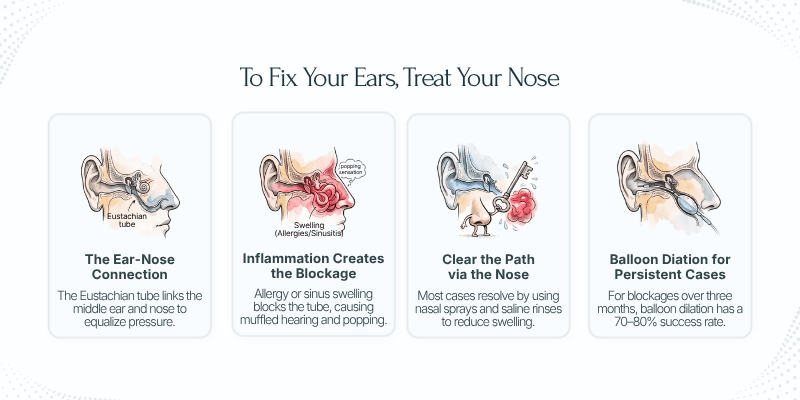
Your Eustachian tube is a small tunnel running from the middle of your ear to the back of your nose. You can’t see it from the outside, but it plays a crucial role in your ear health. When you swallow or yawn, this tube opens briefly to let air into your middle ear, equalizing pressure and keeping everything in balance. This is why pilots and frequent flyers often experience ear discomfort during flights, and why yawning sometimes provides temporary relief.
The lining of your Eustachian tube is continuous with the lining of your nose. This anatomical detail is key because any inflammation or congestion in your nasal passages and sinuses can directly affect how your Eustachian tube functions. Swelling in the nasal lining can trap the tube opening, preventing it from opening properly during swallowing. This is the mechanism behind many common cases of ETD.
Symptoms and How ETD Differs from Ear Infection and Wax
Recognizing the signs
Eustachian tube dysfunction typically presents as ear fullness or pressure, tinnitus (ringing or buzzing sounds), muffled hearing, or that troublesome popping and crackling sensation. Unlike an acute ear infection, which usually comes with sharp pain and sometimes fever, ETD is usually painless and develops gradually. Unlike earwax impaction, which causes sudden hearing loss and is confirmed when wax is visualized in the ear canal, ETD involves clear ears that simply aren’t working optimally.
The distinction matters because treatment depends on the diagnosis. Many people spend money on earwax removal when their real problem is eustachian tube dysfunction treatment targeting the underlying nasal or sinus issue.
The Nose-First Approach: Treating Rhinitis and Sinusitis to Unblock Ears
Why I often start here
When a patient comes to me with ear fullness and I find their Eustachian tubes are structurally normal, the first step is examining the nose and sinuses. Allergic rhinitis, chronic rhinosinusitis, or even ongoing nasal congestion from common viral infections can all trigger or perpetuate ETD. In my clinical practice, I’ve found that addressing these underlying nasal issues resolves eustachian tube dysfunction treatment in the majority of patients.
The approach typically includes intranasal corticosteroid sprays, which reduce inflammation in the nasal lining and Eustachian tube opening. Saline irrigations help clear mucus and reduce swelling. For patients with allergies, identifying and managing allergens, along with antihistamines when appropriate, provides relief. If chronic rhinosinusitis is present, there’s an important hidden connection between nose and ear problems that I’ve detailed in clinical discussions elsewhere.
For patients in Hyderabad’s humid climate, where allergic rhinitis and fungal sinusitis are common, this approach works exceptionally well because treating the primary nasal problem often resolves the secondary ear symptoms without further intervention.
Balloon Eustachian Tube Dilation: Who Benefits and What to Expect
An advanced option for persistent dysfunction
When conservative treatment doesn’t provide adequate relief within 2 to 3 months, balloon dilation of the Eustachian tube is an option worth considering. This minimally invasive procedure uses a small balloon catheter to gently dilate the Eustachian tube opening, improving its ability to open and close properly.
The procedure takes 15 to 20 minutes, is performed under local anesthesia, and patients typically go home the same day. Recovery is rapid, usually within a few days. Studies show success rates around 70 to 80 percent, though it works best for people whose tubes are narrow but structurally normal, and who have failed 3 months of medical management.
I typically recommend balloon dilation for adults with persistent ETD that hasn’t responded to nasal and sinus treatment. For elderly patients, considerations about overall health and other treatments are important, as discussed in more detail in literature on ENT care in the elderly.
Conclusion
Eustachian tube dysfunction treatment is rarely one-size-fits-all, but it almost always starts with understanding the nose-to-ear connection. Whether your symptoms resolve with nasal sprays, saline irrigations, and allergy management, or whether you eventually benefit from balloon dilation, the key is addressing the problem systematically rather than hoping it resolves on its own.
If you’ve struggled with ear fullness, muffled hearing, or that persistent popping sensation for more than a few weeks, I’d recommend scheduling an appointment to understand what’s happening in your nasal passages and Eustachian tubes. Together, we can identify the right eustachian tube dysfunction treatment path for your specific situation. Book your consultation at https://www.sinusdoctor.com/appointment-checkout/ today.
FAQs
No, they’re different conditions. Swimmer’s ear (otitis externa) is an infection of the outer ear canal, usually caused by water exposure and bacteria. Eustachian tube dysfunction affects the middle ear and the tube connecting it to the nose, and it’s usually not infectious. While both can cause ear discomfort, their treatments differ significantly, so proper diagnosis is important.
This depends on the treatment approach. Nasal sprays and decongestants typically show results within 1 to 2 weeks. Saline irrigations may take a few weeks of consistent use. For chronic cases, most doctors recommend giving medical management 2 to 3 months before considering procedures like balloon dilation. Patience is important because the inflammation needs time to resolve.
If you’ve had ear fullness for more than 3 weeks despite trying over-the-counter decongestants or saline rinses, or if the symptoms are affecting your hearing or quality of life, it’s wise to consult a specialist. A best ENT specialist in Hyderabad or your area can distinguish between ETD, earwax impaction, and actual ear infections, and recommend the right eustachian tube dysfunction treatment. Visit https://www.sinusdoctor.com/ to learn more about expert evaluation and care.