As an ENT surgeon, I often see patients who arrive at my clinic feeling completely defeated. They aren’t there because of a stuffy nose problem or a sinus headache; they are there because of their ears.
I consult many patients who have suffered from constant ear discharge for years. One such patient, a 40-year-old software engineer, came to me after two full years of using various ear drops that provided only temporary relief . The discharge would stop for a few days, only to return with a vengeance. He was convinced he had a “bad ear,” but when I began my examination, I didn’t start with his ear—I started with his nose.
The “twist” in many of these stories is that the real problem isn’t in the ears at all. Often, severe chronic sinusitis or a deviated nasal septum is the true culprit that must be treated before the ear can ever truly heal .
The Hidden Anatomy: The Bridge Between Ear and Nose
To understand why your nose holds the key to your ear health, we have to look at a bit of “hidden” anatomy. The ear is composed of three main parts: the outer, middle, and inner ear.
The middle ear is a small, air-filled chamber that sits directly behind your eardrum. This chamber is connected to the back of your nose by a thin, specialized passage called the Eustachian tube.
Think of the Eustachian tube as your ear’s personal ventilation system. Every time you swallow, yawn, or chew, this tube is supposed to open. Its job is to allow fresh air into the middle ear, drain any natural fluid into the throat, and equalize the air pressure between your head and the outside world. When your nose is healthy, this system works silently in the background. But when nasal issues arise, it triggers a dangerous domino effect.
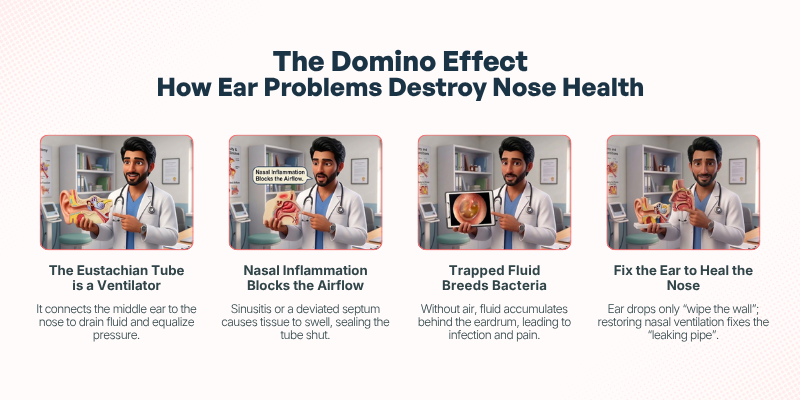
The Domino Effect: How Nose Problems Destroy Ear Health
When I explain this to my patients, I break it down into four distinct stages of how a nose problem “migrates” to become an ear problem:
Stage 1: The Blockage
It begins with nasal inflammation. Whether it is due to chronic sinusitis, a deviated septum, or even severe allergies, the tissue in the nose and around the opening of the Eustachian tube begins to swell. This prevents the tube from opening and closing as it should.
Stage 2: The Fluid Trap
Because the Eustachian tube is blocked, air can no longer enter the middle ear. This creates negative pressure, and fluid—which should have drained away—begins to accumulate behind the eardrum. At this stage, patients usually complain of a “blocked” sensation or strange popping sounds.
Stage 3: Infection and Pain
Stagnant fluid is a breeding ground for bacteria. Eventually, that trapped fluid becomes infected. This leads to the hallmark symptoms of a middle ear infection: sharp pain, a feeling of fullness, and significantly reduced hearing.
Stage 4: Severe Damage and Discharge
If this cycle of infection is left untreated, the pressure from the infected fluid can become so great that it causes a hole, or perforation, in the eardrum. This leads to the chronic ear discharge that many patients mistakenly try to treat with drops alone.
The "Leaking Pipe" Analogy: Why the Nose Comes First
I often use an analogy from The Sinus Book to help my patients visualize this: “If you have a leaking pipe behind a wall, simply wiping the wet wall won’t solve the problem”.
Treating only the ear with drops is like wiping that wet wall. You are cleaning up the symptom, but you aren’t fixing the source. If the “leaking pipe”—the underlying nasal obstruction or sinus infection—is still there, the wall will just keep getting wet.
In my practice at Dr. Rao’s ENT, I prioritize identifying the root cause. Sometimes, this means performing a septoplasty or endoscopic sinus surgery to clear the nasal passages before we even consider an ear procedure. Once the “ventilation” is restored through the nose, the ear often begins to heal naturally.
Taking the First Step Toward Healthy Ears
If you or a loved one are suffering from chronic ear infections, muffled hearing, or persistent discharge that won’t go away, it is time to look at the bigger picture. Getting your nose healthy is the first essential step to having healthy ears.
I encourage you to consult an ENT specialist who can perform a thorough examination of your nasal passages and sinuses. Don’t settle for “wiping the wall”—fix the pipe.
Learn More and Get Expert Care
Educate Yourself: For more surprising insights into how your nasal health impacts your entire body, read my comprehensive guide, The Sinus Book, available now on Amazon.
Expert Consultation: If you are experiencing chronic ear or sinus issues, you can schedule a professional evaluation with me, Dr. GVK Chaitanya Rao, at Dr. Rao’s ENT Super Speciality International Hospital. Schedule Your Appointment Online
Stay Informed: Follow the journey to better breathing and hearing on my YouTube channel and Instagram page for daily, jargon-free medical tips.
FAQs
Yes, nose problems like sinusitis or a deviated septum can block the Eustachian tube, leading to ear infections, pressure, and hearing issues.
The ear and nose are connected through the Eustachian tube, which helps regulate pressure and drain fluid from the middle ear.
Recurring ear discharge often happens because the root cause—usually a nasal or sinus problem—is not treated properly.
If you have symptoms like nasal blockage, sinus infections, and repeated ear issues together, your nose may be the underlying cause.
Yes, treating sinusitis or nasal blockage can restore proper airflow and drainage, helping ear conditions heal naturally.
You should consult an ENT specialist if you have chronic ear discharge, hearing loss, or persistent nasal congestion that doesn’t improve with treatment.