If you have nasal polyps, you’ve likely noticed your voice sounds different. Maybe you sound perpetually “blocked up,” or people struggle to understand you. Perhaps you feel self-conscious speaking in meetings or making phone calls. While you know surgery might help you breathe better, a natural concern arises: will I experience a voice change after nasal polyp surgery, or could it make things worse?
The straightforward answer is no, it won’t make things worse. In fact, most patients find their voice improves after surgery. But let’s talk about what actually happens, why it happens, and what you can do to support your voice during recovery.
How Nasal Polyps Change Your Voice
To understand voice changes, think about how your voice is actually created. Your vocal cords vibrate to produce sound, but that raw sound isn’t what comes out of your mouth. The sound travels through your nose, sinuses, mouth, and throat, which all act as resonators. Together, they shape and color your voice.
Nasal polyps are swollen growths of the nasal lining that obstruct the nasal passages. This obstruction disrupts how air flows and sound resonates through your nose. Depending on the size and location of your polyps, you might experience:
- Hyponasality (the most common): Your voice sounds like you’re “holding your nose” or have a bad cold. The letters “m” and “n” sound wrong. You might say “bada” instead of “mama” or “wed” instead of “red.”
- Hypernasality (less common, but possible with very large polyps): Your voice takes on an overly nasal quality where air escapes through your nose too much during speech.
- Voice fatigue: Your vocal cords work harder to push sound through the blocked passages, leaving you tired or hoarse by the end of the day.
- Reduced vocal projection: You feel like you have to strain to be heard, especially in group settings.
These changes aren’t trivial. They affect how people perceive you, how you feel about yourself, and your ability to communicate effectively at work and in social situations.
What Happens to Your Voice After Surgery?
Functional endoscopic sinus surgery (FESS) removes the polyps and opens up the nasal passages, restoring normal airflow and resonance. This means your voice should improve, not worsen. Here’s why:
The surgery doesn’t touch your vocal cords. Your vocal cords sit lower in your throat, in the larynx. FESS works only in the nose and sinuses. Therefore, there is no risk to the delicate mechanics of voice production. What changes is the resonance and airflow around your voice, which almost always improves.
Research supports this. Studies show that after polyp removal, patients experience better nasal resonance, improved ability to pronounce nasal sounds clearly, and most importantly, higher satisfaction with how their voice sounds.
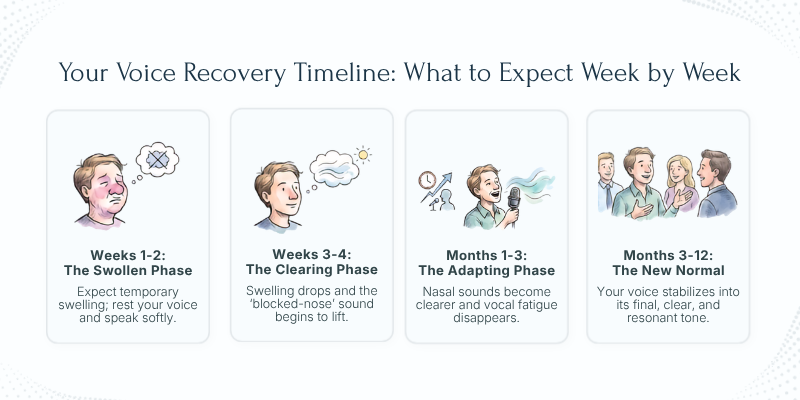
Your Voice Recovery Timeline: What to Expect Week by Week
Weeks 1-2: Immediate Post-Op (The Swollen Phase)
Right after surgery, your nasal passages are swollen and packed with dissolvable packing or gauze. You may feel like you sound even more blocked initially. This is completely normal and temporary. You’ll be advised to keep your head elevated, avoid blowing your nose, and be gentle with your voice.
What to do: Rest your voice gently. Avoid shouting, excessive talking, or singing. Speak in a normal conversational tone but don’t strain. Your nose needs to heal without pressure.
Weeks 3-4: Early Improvement (The Clearing Phase)
Swelling begins to decrease, the packing is removed, and your nasal passages start to clear. This is often when patients notice the most dramatic change. Suddenly, breathing feels easier, and your voice sounds different in a good way. The blocked, nasal quality begins to lift. Many patients are pleasantly surprised by how quickly they sound more normal.
What to do: You can gradually return to normal voice use. Speaking at your usual volume is fine. Light singing or voice use is generally okay, but avoid extended periods of heavy voice use like long presentations or rehearsals.
Months 1-3: Progressive Improvement (The Adapting Phase)
As swelling continues to resolve and your nasal passages fully open, your voice continues to improve. The improvement may seem gradual now, but comparing your voice from month 1 to month 3, you’ll notice a clear difference. Nasal consonants become clearer. You sound and feel more confident. The voice fatigue you used to experience may disappear.
What to do: You can resume normal voice activities. If you’re a professional voice user (singer, teacher, speaker), this is a good time to gradually return to your usual demands, assuming your surgeon has cleared you.
Months 3-12: Stabilization and Long-Term Improvement (The New Normal Phase)
By three months, most voice improvement has occurred. However, subtle improvements can continue for up to a year as your body fully adapts to the new nasal anatomy. Some patients report their voice continues to sound even better at the six-month and one-year marks.
What to do: Continue normal voice use. Pay attention to your voice health going forward. Stay hydrated, avoid smoking, and avoid straining your voice, just like anyone should.
Practical Tips for Supporting Your Voice During Recovery
Immediately After Surgery (First 2 Weeks)
o Stay hydrated. Drink plenty of water. A humidifier in your room helps keep air moist and supports healing.
o Avoid hot foods and beverages for 24-48 hours after surgery (risk of bleeding).
o Sleep with your head elevated on 2-3 pillows to reduce swelling.
o Do not blow your nose. If you need to clear nasal secretions, gently sniff back or use saline irrigation as directed.
o Avoid strenuous activity and heavy lifting.
Weeks 3-6
o Continue saline nasal irrigation as prescribed to keep healing tissues clean.
o Use a humidifier, especially in dry climates or during winter.
o Continue voice rest if you work in a voice-intensive profession. Transition gradually back to full use.
o Avoid irritants like smoke, strong perfumes, and heavily polluted areas.
Beyond 6 Weeks
o Maintain good hydration. Dry mucous membranes can irritate your healing nose.
o Consider voice lessons or coaching if you’re a professional voice user, to ensure you’re using optimal technique post-op.
o Avoid smoking and limit alcohol, which can cause nasal congestion and affect voice resonance.
When Should You Contact Your Doctor About Voice Change After Nasal Polyp Surgery?
Most voice-related changes after surgery are normal and expected. However, contact your surgeon if you experience:
- Persistent hyponasality or hypernasality beyond 3 months
- New onset voice hoarseness or roughness (especially if it persists beyond 4-6 weeks)
- Severe voice fatigue or loss of vocal range that doesn’t improve
- Concerns that your voice is getting worse rather than better
- Sudden changes like pain during speaking or swallowing
These symptoms warrant evaluation to ensure your healing is progressing normally.
Is Nasal Polyp Surgery Safe for Professional Voice Users?
If you rely on your voice for your work—whether you’re a singer, teacher, actor, public speaker, or podcaster—you have legitimate concerns about surgery. The good news is that FESS is considered safe and beneficial for professional voice users. Here’s why:
The surgery doesn’t affect vocal cord function. It improves nasal airflow and resonance, which actually helps voice projection and reduces fatigue. Many professional voice users report they sound and perform better after surgery once recovery is complete.
That said, be strategic about your timeline. If possible, schedule surgery during a period when you can reduce voice demands during the first 2-3 weeks. Discuss your specific voice needs with Dr. Chaitanya Rao before surgery so you can plan your return to full voice use safely.
The Bottom Line
Nasal polyps do change your voice, and not in a good way. But removing them restores your voice to normal and often improves it further. The improvement happens gradually over weeks and months, but the trajectory is reliably upward. By three to six months post-op, most patients sound like themselves again—or better than they have in years.
If nasal polyps have been holding you back socially, professionally, or personally because of voice changes, surgery is a well-established, safe solution. The benefits extend far beyond breathing better; they include reclaiming your confidence, your communication, and your voice.
Dr. Chaitanya Rao has performed over 15,000 sinus surgeries and specializes in helping patients achieve the best possible outcomes. If you’re considering surgery and want to discuss how it might affect your specific situation, we’re here to help.
Ready to get your voice back? Schedule a consultation with Dr. Chaitanya Rao today.
FAQs
Nasal polyps obstruct airflow through your nose. When you speak, the sound needs to resonate through your nasal cavity to produce clear nasal consonants like “m” and “n.” With blockage, sound can’t pass through normally, so your voice takes on a “pinched nose” or “blocked nose” quality. It’s like trying to hear someone talking through a wall. Once the polyps are removed and airflow is restored, your voice returns to normal resonance.
Most improvement happens in the first four weeks as swelling resolves. By one month, many patients notice dramatic improvement. However, subtle improvements continue through month three, and some patients find their voice improving even up to six months or a year. The timeline varies, but if you haven’t seen significant improvement by three months, discuss this with your surgeon to ensure healing is progressing normally.
No. During the first two weeks, your nose is healing and should be rested. From weeks three to six, you can engage in light voice use with normal conversation. By six to eight weeks, most people can return to regular activities. If you’re a professional voice user, plan for at least 2-4 weeks of reduced voice demand post-op, and discuss a gradual return-to-work timeline with Dr. Chaitanya Rao. Some professionals choose to take longer depending on their specific voice demands.
No. The surgery doesn’t touch your vocal cords, which sit in your larynx below your nose. FESS only removes polyps and opens nasal passages. Voice quality improves when breathing passages are restored, not worsened. The only time voice might sound different temporarily is in the first week or two due to swelling, which resolves as you heal.
Mild changes in voice quality during the first few weeks are normal as swelling resolves. However, persistent hoarseness, roughness, or new voice problems beyond four to six weeks warrant a call to your surgeon. These are usually not related to nasal surgery itself but should be evaluated to ensure proper healing.